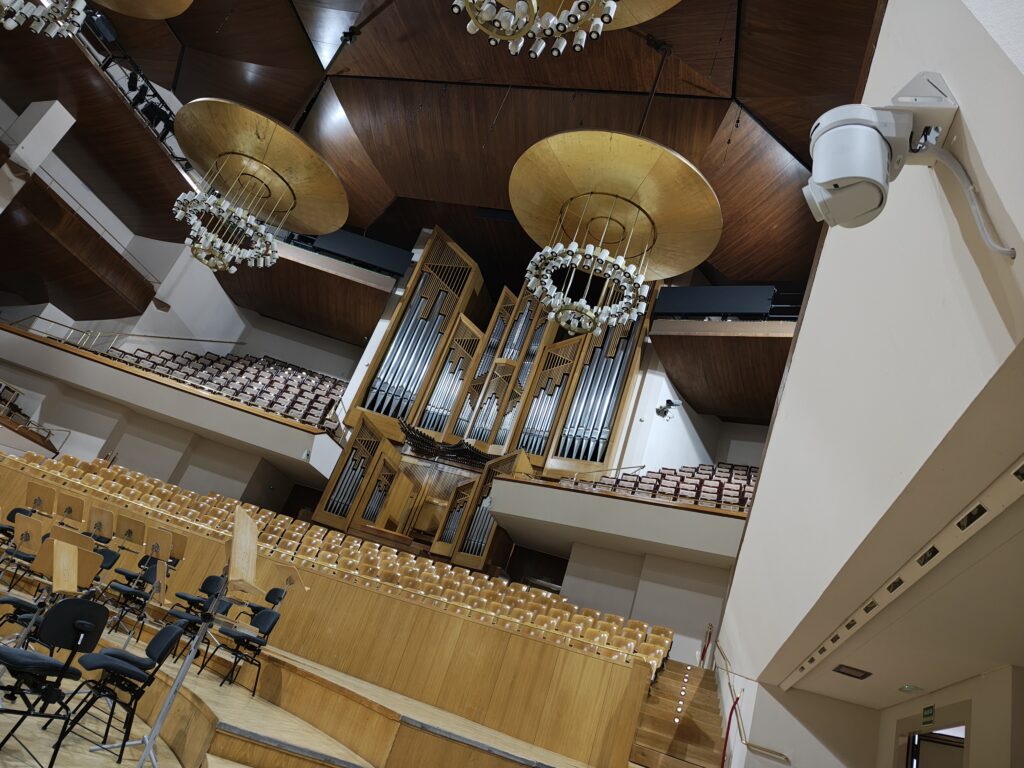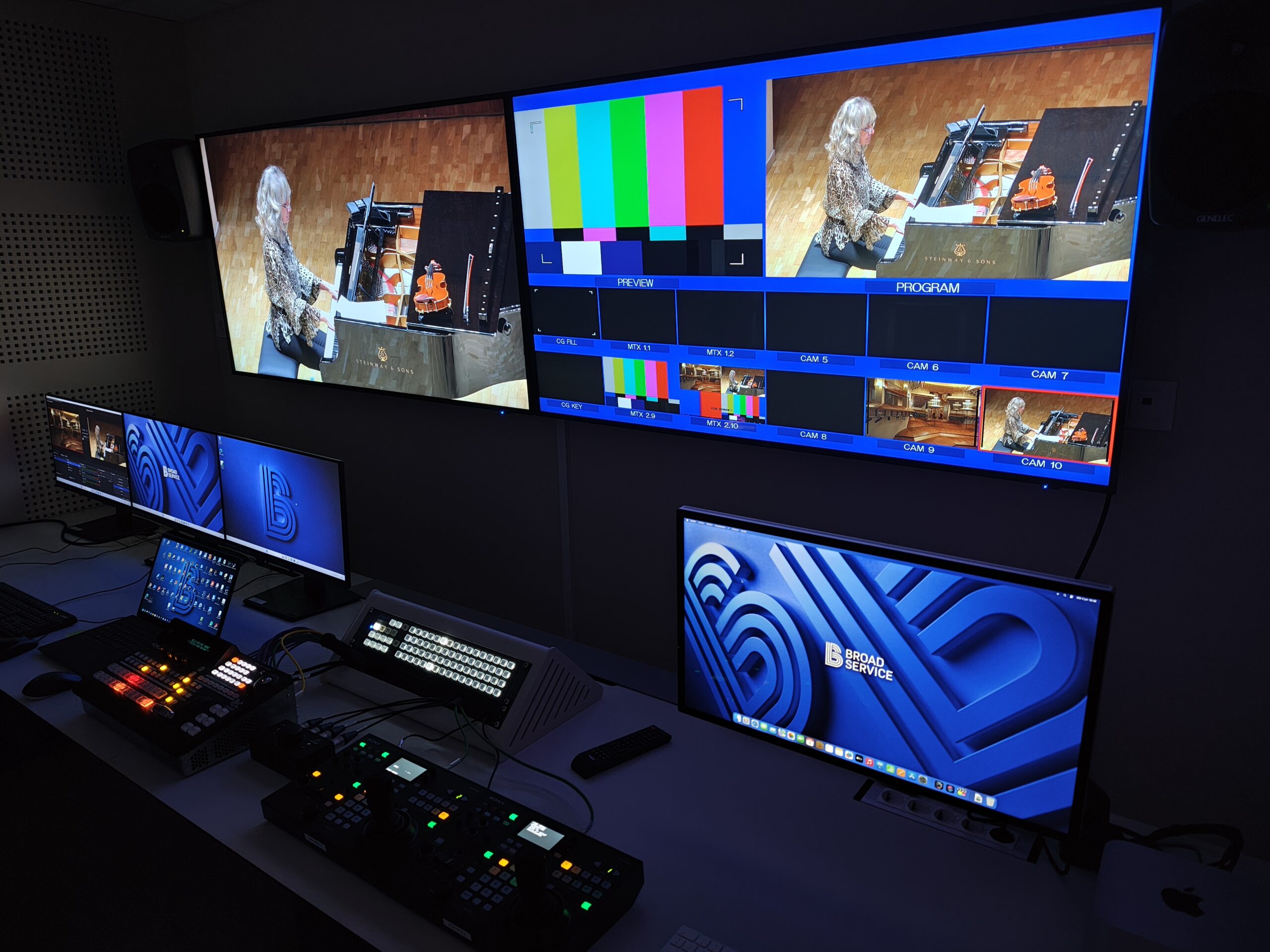
The company has supplied and installed camera and sound systems for video recording and monitoring in concert halls.
This news item is taken from an article published by TM Broadcast magazine, which can be found here.
Broad Service has just completed the supply and integration of audiovisual equipment for the National Music Auditorium. The new system aims to enable live streaming and video and audio editing of any concert or event taking place in the Auditorium, according to a statement released by the company.
The first link in the chain is Sony’s BRC-X1000 PTZ cameras, which are responsible for capturing every corner of the stage, both in the Symphony Hall and the Chamber Hall. Likewise, for image recording, an 8-input multi-channel recording system with 2 paired AJA Ki Pro Ultra 12G devices has been set up to master the 7 cameras supplied and record the mixed and labeled program signal, or any other desired combination according to the matrix routings.
This material is then collected in Final Cut Pro installed on a MAC Studio M2, where it can be edited and transcoded into any broadcast format, as well as sharing its proxy reference version with the Audio DAW. At the same time, the concert can be broadcast live via multi-platform streaming through the dedicated workstation and software with exclusive Internet output for this purpose.
In terms of audio, the main element of the system is the Midas HD96-24 IP mixing console, with a native sampling frequency of 96 kHz, a 64-bit non-floating point mixing engine, 18 sharcs for DSPs, and 5 8th generation FPGAs. It includes 144 input channels, 123 mix buses, connectivity in multiple proprietary and standard formats, internal effects racks, cloud connection for saving and importing work shows, and a touch interface.
The console has been complemented with two DL series stage boxes, a 431 as a microphone splitter and a 251 mobile in a flight case for the stage, connected and controlled by the console via its AES50 ports. Point-to-point transmission via AES50 aims to ensure 24 channels per line with the lowest possible latency.
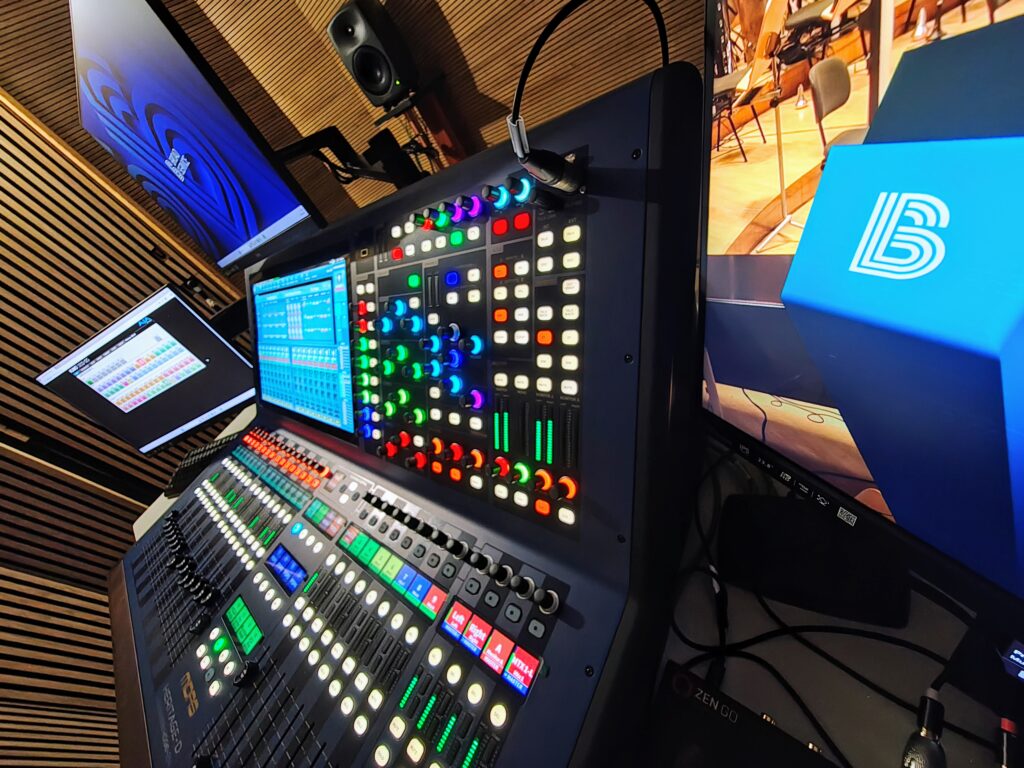
The rest of the system and audio infrastructure, in addition to the conversion from analog to AES50, includes links via MADI, Dante, and AES3. Interoperability between them is achieved using an Antelope Orion 32+ Gen 4 interface and an Appsys MVR MKII multiformat converter with SRC-128 module, which also allows sample rate conversion if it is necessary to go beyond the 96 kHz range.
For multitrack audio recording, a DAW station equipped with Magix’s Sequoia Pro 17 has been installed, with 512 inputs, 32-bit floating point processing, non-destructive 4-point source-destination editing, multiple asymmetric crossfade capability, multisynchronous cuts and inserts from various takes, and dozens of VST plug-in functions.
The studio has also been equipped with various measurement, monitoring, and calibration tools, such as Genelec’s auto-tuning monitor, a TC Clarity M multi-format loudness meter, and Global Audio’s RiTA FFT analyzer.
In terms of infrastructure, two new controls have been designed and installed, one for video and one for audio, with the corresponding technical equipment. In addition, the existing system in the Auditorium has been supplemented with a series of additional panels and tie-lines between rooms, booths, and controls, which are intended to reach any SDI HD and 4K video point, analog, digital, and AES50 audio, and the Control, Internet, Dante networks, or any possible future additions via fiber or copper.
Finally, in terms of the internal operation of the Auditorium, the dressing rooms, a series of offices, and certain public passageways have been equipped with NEC MultiSync series monitors, to which the program signal or the monitoring signal deemed most appropriate at any given time is distributed. The aim of this is to enable Auditorium staff, musicians, and the public to know at all times what stage of the performance, rehearsal, or preparation the halls are at.
Finally, the supply has been completed with a plethora of equipment to try to improve sound capture at concerts. These include reference-level microphones, such as the prestigious Schoeps M4 and MK2S capsules, paired with their CMC 1U or CM6 amplifiers, Neumann KM 184 stereo kits, specially designed for pianos, strings, and woodwinds, and KMS 105 kits, ideal for vocals.