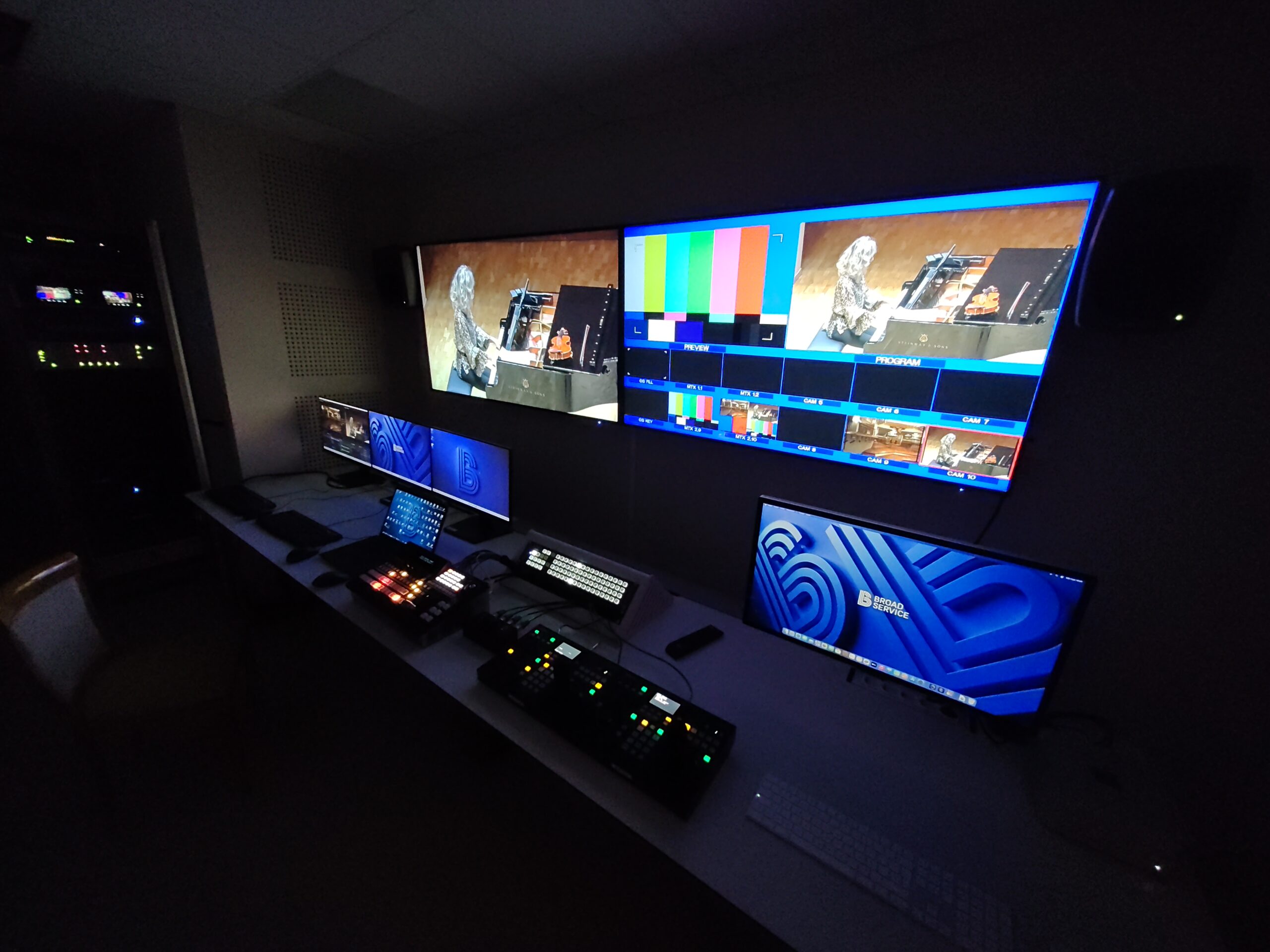
To mark its twentieth anniversary, Broad Service has carried out a major project involving the supply and integration of audiovisual equipment in the National Music Auditorium. Once operational, the system will enable both live streaming of concerts and events held in the Auditorium and multitrack audio and video editing of the works performed.
Supply and integration of audiovisual equipment for the National Music Auditorium
- Broadcast

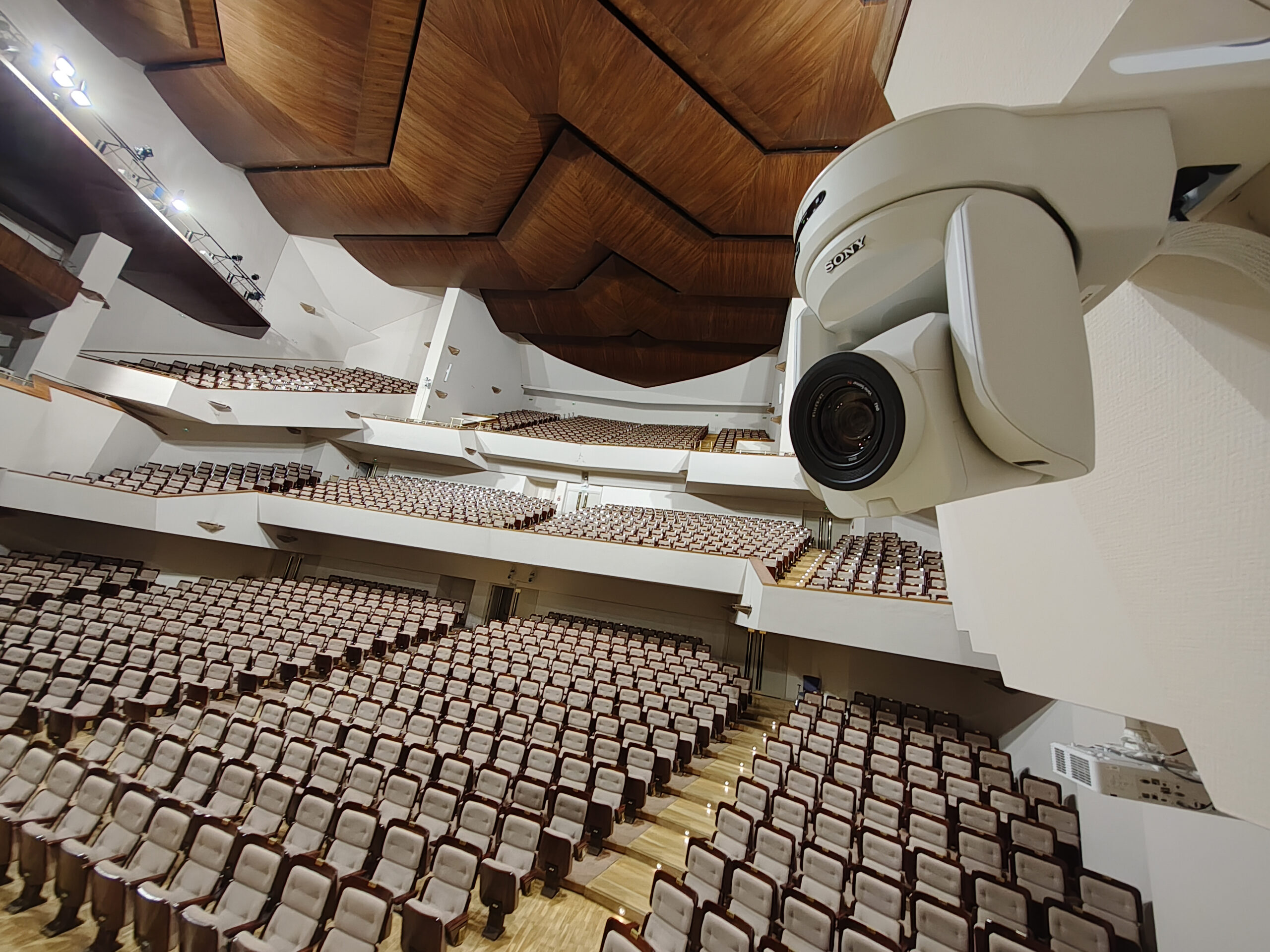
The first component in the image capture chain is the Sony BRC-X1000 PTZ cameras, selected for their 4K resolution and high light sensitivity, which allows for high-quality image acquisition even in low-light conditions. These units have been strategically distributed to comprehensively cover both the Symphony Hall and the Chamber Hall, ensuring full coverage of the stage. Each camera has a 12x optical zoom, which can be extended using the Tele function, allowing the operator to pan accurately over specific areas and capture fine details, such as the musicians’ instrumental performance, without any loss of definition. The system configuration facilitates switching between detailed shots and overviews using predefined angular positions, optimizing the complete view of the orchestra and the hall, ensuring a continuous and versatile image flow for professional audiovisual production.
For image recording, an 8-input multi-channel recording system has been set up with two paired AJA Ki Pro Ultra 12G devices, allowing for the mastering of the seven supplied cameras and the recording of the mixed and labeled program signal, or any other desired combination according to the matrix routings. This material is then collected in Final Cut Pro installed on a MAC Studio M2, where it can be edited and transcoded into any broadcast format, as well as sharing its proxy reference version with the Audio DAW. At the same time, the concert can be broadcast live via multi-platform streaming thanks to the dedicated workstation and software with exclusive Internet output for this purpose.
The audio system installed in the National Music Auditorium is centered around the Midas HD96-24 IP digital console, which operates at a sampling frequency of 96 kHz and a 64-bit mixing engine, providing a wide dynamic range and high processing precision. The console supports up to 144 input channels and 123 mix buses, with connectivity in multiple formats, internal effects racks, and cloud integration capability for configuration storage, complemented by a customizable touch interface, 18 DSPs, and 5 eighth-generation FPGAs that ensure future scalability.
The stage infrastructure is completed with two DL series stage boxes (431 fixed and 251 mobile), interconnected via AES50, ensuring 24 channels per line transmission with minimal latency. Interoperability between analog and digital systems is ensured by MADI, Dante, and AES3 links, supported by an Antelope Orion 32+ Gen 4 interface and an Appsys MVR MKII multiformat converter with SRC-128 module, allowing sample rate adjustments according to operational needs.
For multitrack recording and professional post-production, a DAW station with Magix Sequoia Pro 17 has been installed, capable of handling 512 inputs, non-destructive editing, asymmetric crossfades, multisynchronous cuts, and the use of VST plugins. The system is complemented by professional calibration and monitoring tools, including Genelec auto-tuning monitors, Clarity M loudness meter, and Global Audio’s RiTA FFT analyzer, ensuring precision and total audio control at all stages of the workflow.
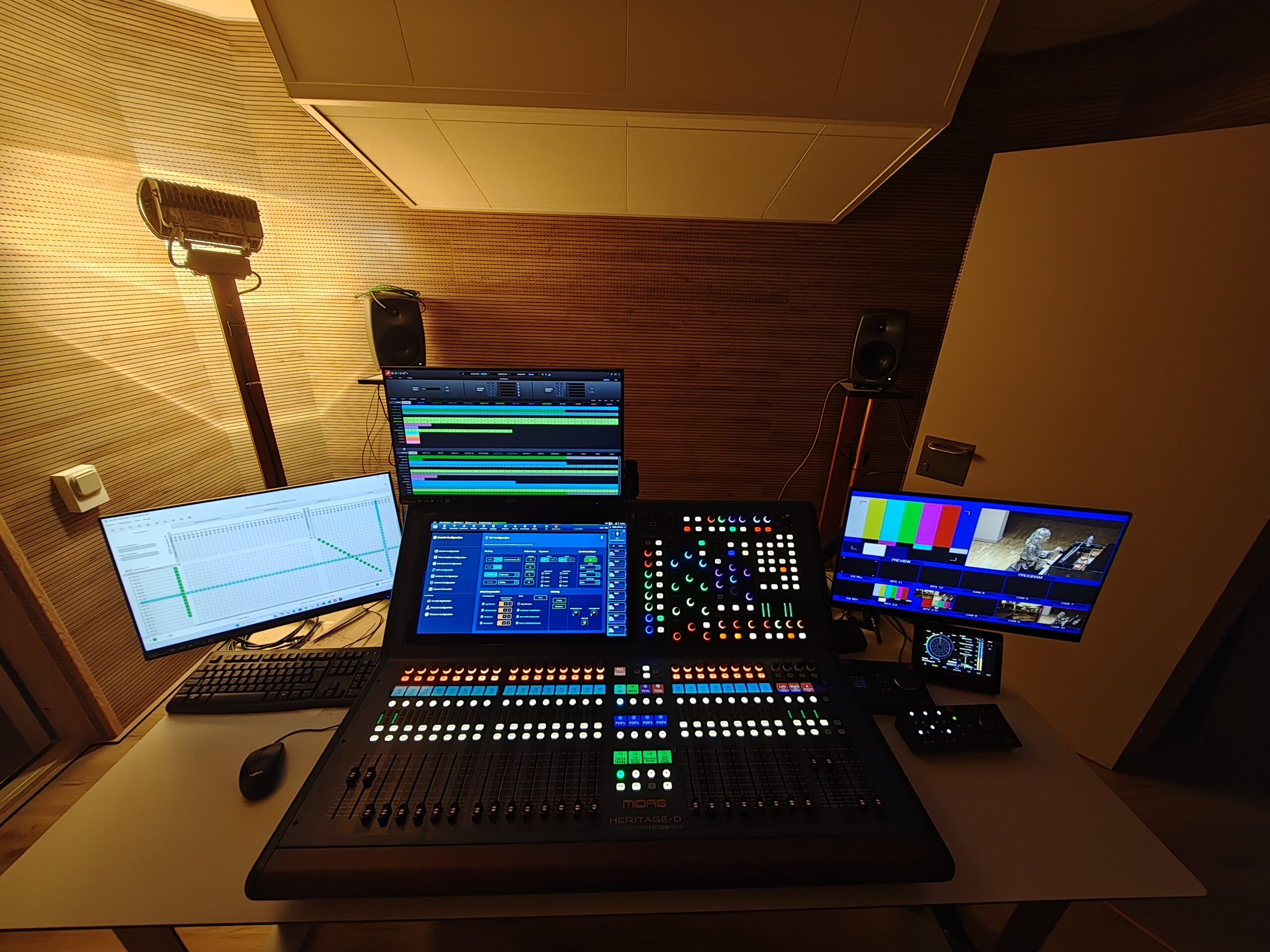
In terms of infrastructure, two new control rooms have been designed and implemented, one for video and the other for audio, equipped with specialized technical furniture. These facilities have been integrated with the existing infrastructure by incorporating additional panels and tie-lines between rooms, booths, and controls, allowing for the distribution of SDI video signals in HD and 4K, audio in analog, digital, and AES50 formats, as well as control networks, Dante, Internet, and future expansions via fiber optic or copper, ensuring flexibility and scalability in the Auditorium’s operations.
In addition, all dressing rooms, offices, and certain public transit points have been equipped with NEC MultiSync series monitors. These monitors receive the corresponding program or tracking signal, depending on operational needs, allowing technical staff, musicians, and the public to know at all times the progress of the performance, rehearsal, or preparation of the rooms, optimizing internal coordination and event supervision.
Complementing the infrastructure, a complete range of reference microphones and equipment has been supplied and put into operation to improve sound capture at concerts. Noteworthy among the equipment installed are Schoeps M4 and MK2S capsules paired with CMC 1U and CM6 preamplifiers, Neumann KM 184 stereo kits for string instruments and piano, and KMS 105 microphones for vocal pickup. With the integration of these systems and equipment, the National Auditorium has achieved a level of technology comparable to that of internationally renowned venues, offering extensive professional production and broadcasting possibilities equivalent to those of institutions such as the Teatro Real, the Berliner Philharmonie, and the Musikverein in Vienna.